Ó
2000, S. D. Cochran. All rights reserved.BINOMIAL COEFFICIENTS
A. Sometimes we wish to know exactly the probability of a particular outcome. We can use the binomial formula to determine this.
1. Imagine this: You meet someone you really, really like. But you are not sure if he or she likes you quite as much as you like them. You decide to use the old tried and true method of determining their intentions. You go out into a pretty spot and pick several flowers with petals. Then you sit down and say to yourself, "Oh boy, this is it. If I can have five flowers in a row come out right, I'll know I can be sure." Well, what are the chances that you are going to be successful? You begin the process: "They love me. They love me not. They love me. They love me not." Until you know the outcome of the first flower. So what is the probability that you will observe five flowers in a row with the "They love me" outcome?
2. First we might ask how many ways can this experiment come out?
a. We could enumerate it laboriously by hand: Let's specify a "loves me" outcome as and L and a "Loves me not" outcome and an N, and let's assume that the number of petals on the flowers is distributed randomly between odd and even numbers (this is obviously not true…so how would this affect the situation we are describing?…but for the moment, assume that the process is random with two possible outcomes of equal probability)
0 Love me's |
1 Love me's |
2 Love me's |
3 Love me's |
4 Love me's |
5 Love me's |
NNNNN |
LNNNN |
LLNNN |
LLLNN |
LLLLN |
LLLLL |
|
NLNNN |
LNLNN |
LLNLN |
LLLNL |
|
|
NNLNN |
LNNLN |
LLNNL |
LLNLL |
|
|
NNNLN |
LNNNL |
NLLLN |
LNLLL |
|
|
NNNNL |
NLLNN |
NLNLL |
NLLLL |
|
|
|
NLNLN |
LNLNL |
|
|
|
|
NLNNL |
NLLNL |
|
|
|
|
NNLLN |
LNNLL |
|
|
|
|
NNLNL |
NLNLL |
|
|
|
|
NNNLL |
NNLLL |
|
|
b. As you can see, there is only 1 outcome that matches your criterion (5 flowers in a row ending in "Love me" out of 32 possible outcomes. So your chances are 1 in 32 or about 3%.
c. The other thing you might notice is that these outcomes have the look of a distribution that may look somewhat familiar. The distribution here is called a binomial distribution (it is a distribution of possible types of outcomes from a binomial variable). And, when the number of trials is very large, this distribution approaches the normal distribution.
3. It turns out that we can use the binomial formula to tell us how many outcomes are possible from this binomial (two outcome--loves me, loves me not) situation.
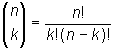
a. The first part of the formula is the binomial coefficient:
![]()
The are four concepts in this formula.
2. The second concept is k, or the number of elements or objects that are alike. So, one possibility is a situation of 5 "loves me" outcomes. Here k = 5.
3. The third concept is the ! or exclamation point, which is called a factorial sign. Just like the * or multiplication sign it indicates that you are to do a certain mathematical operation. The operation is to multiply the number indicated by itself minus one until you get to one. For example, 4! = 4 X 3 X 2 X1 = 24. If the number is 0, and we wish to do 0!, the answer is defined as 1.
4. The final concept is the bracket containing n and k, which indicates a binomial process. This is not related to fractions, and is read "the binomial coefficient n choose k".
b. This formula tells us how many different ways we can arrange n objects or elements, when k of those of objects are of one type and n - k are of another. For example, the binomial coefficient tells that there is:
![]()
Exactly one way in which we can arrange 5 "love me" outcomes. It we wanted to know how many types of 4 "love me" outcomes we could obtain, the answer is:
![]()
Notice, that with factorials there is a lot of cancellation that can done to simplify the math.
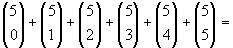
4. Now if we wanted to know how many possible ways the flower exercise would come out if we conducted the exercise 5 independent times, we would simply add up the 5 binomial coefficients. So:
![]()
![]()
![]()
1 + 5 + 10 + 10 + 5 + 1 = 32
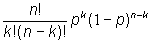
5. The second part is the binomial formula which states that the chances that something will occur k times out of n is:
![]()
a. We have to specify three assumptions for this to be true:
1. The value for n must be fixed in advance--that is we must know exactly how many objects we will sample, how many trials will occur.
2. The probability of the event occurrence, or p, is fixed also--it must be same across all the trials
3. Each trial is independent--that is the outcome of any trial does not alter in any way the outcome of any other trial.
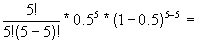
b. So for the example of what are the chances that you would observe 5 times in a row the outcome of "They love me", the formula tells us that it should be (remember: anything raised to the zero power is 1):
![]()
![]()
Or about a 3% chance. Pretty good for a formula--takes the work out of figuring out things. But pretty bad for your chances that the person really loves you.