



For this particular sample, we find that  ,
n=5, and from the last row of Table C,
,
n=5, and from the last row of Table C,  . Put it
all together, and our confidence interval is
(14.068, 15.068).\
. Put it
all together, and our confidence interval is
(14.068, 15.068).\

which turns out to be s = .660 (remember to take the square root
to get s from  ). The confidence interval is

where  comes from
Table C, in the row corresponding to 4 df (n-1=4) and the column
corresponding to 90%. Thus,
comes from
Table C, in the row corresponding to 4 df (n-1=4) and the column
corresponding to 90%. Thus,  . The confidence interval
is thus (13.939,15.177).
. The confidence interval
is thus (13.939,15.177).
The correct interpretation of these intervals is: if you know that the standard deviation is .68, then 90% of all confidence intervals calculated as in part a will contain the true value of the mean. So the interval we found is either one of these that contains the true value, or it is not. There is a 10% chance it is not. If we don't know the standard deviation and have to estimate it, then the same interpretation applies to the wider interval in part b.


And this equals  . So it's pretty
unlikely a pig could get nine or more correct if he's just guessing.
So if you saw a pig do this, you'd either have to believe you'd just
witnessed a very rare event, or something fishy was going on.
. So it's pretty
unlikely a pig could get nine or more correct if he's just guessing.
So if you saw a pig do this, you'd either have to believe you'd just
witnessed a very rare event, or something fishy was going on.
 represent the proportion correct in this sample. The question
then asks you to find
represent the proportion correct in this sample. The question
then asks you to find  .
.
You can't use the normal approximation here (why not?), so instead notice
that if you have 10 trials and 30 percent of them are successess, then
you must have had 3 successess. So this question is exactly the same
as asking for  . In other words, we've turned it back
into a question about counts. The solution is
. In other words, we've turned it back
into a question about counts. The solution is

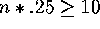 , or, in other
words, if
, or, in other
words, if  .
.


This is a one-sided because we're interested in discovering if the pig gets more than 25% of his answers correct.
 . So we want to find
  when p = .25. But this is exactly the problem we solved in part (b),
and so the answer is the same.
when p = .25. But this is exactly the problem we solved in part (b),
and so the answer is the same.
 lies on the regression line. From this fact
we get the formula for the intercept:
lies on the regression line. From this fact
we get the formula for the intercept:  which
gives a = 98.6. The reason this is so high is because the slope
is negative: students who scored well on the first test tended to not
score well on the second.
which
gives a = 98.6. The reason this is so high is because the slope
is negative: students who scored well on the first test tended to not
score well on the second.
The correlation is given by remembering the formula for the slope:

so that 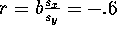 .
.